
spacer spacer spacer spacer spacer spacer spacer spacer
spacer
spacer
    Latest Accounting News

Telephone: 03 9727 1244
Facsimile: 03 9727 0244
Email: Email Us

Address: Suite 2, 96 Manchester Rd, Mooroolbark VIC 3138
spacer
Hot Issues
Steps to close a business
Paid parental leave super contributions have started
How Do I Write Legally Compliant Terms and Conditions for My Business?
Don’t get caught out at tax time with your multiples jobs
Division 296 tax on large super balances
More of the same with latest missive from Treasury
'No place to hide': ATO puts contractors on notice over $1bn in missing TPAR payments
Check out the largest castles by country
ATO no longer treating debt the same as during COVID
Warning for early lodger this tax time!
Global companies turn to cost-cutting amid ongoing inflation
Don’t get caught out at tax time with your multiples jobs
Does Your Small Business Need to Follow AML Privacy Rules?
SMEs warned as ATO ramps up tax debt collection
Taxpayer given 35% penalty for BAS recklessness
How Our Diets have Changed.
Tips to help you this tax time
Tax Time Checklists Individuals; Company; Trust; Partnership; and Super Funds
ATO warns millions of Australian chasing tax deductions to stop making 'unusual' claims
Impersonation scams are on the rise
Components of a cyber security plan
Social Security Payments and Their Effect on Discretionary Trusts
LRBA ban no better for housing supply or retirement, accountants clap back
The evolution of the world's languages
2026 Year-End Tax Planning Guide – Part 1
2026 Year-End Tax Planning Guide – Part 2
PAYDAY SUPER STARTS 1 JULY 2026 – Planning guides
Payday Super: 6 Things Small Businesses Need to Know
SMEs to be hit hardest by new trust tax reforms
6 tips to help businesses avoid financial difficulties
Managing your mental health and wellbeing during times of uncertainty
Check out what Uses the Most Internet Traffic: Data from 1994 to 2026
Articles archive
Quarter 2 April - June 2026
Quarter 1 January - March 2026
Quarter 4 October - December 2025
Quarter 3 July - September 2025
Quarter 2 April - June 2025
Quarter 1 January - March 2025
Quarter 4 October - December 2024
Quarter 3 July - September 2024
Quarter 2 April - June 2024
Quarter 1 January - March 2024
Quarter 4 October - December 2023
Quarter 3 July - September 2023
Quarter 2 April - June 2023
Quarter 1 January - March 2023
Quarter 4 October - December 2022
Quarter 3 July - September 2022
Quarter 2 April - June 2022
Quarter 1 January - March 2022
Quarter 4 October - December 2021
Quarter 3 July - September 2021
Quarter 2 April - June 2021
Quarter 1 January - March 2021
Quarter 4 October - December 2020
Quarter 3 July - September 2020
Quarter 2 April - June 2020
Quarter 1 January - March 2020
Quarter 4 October - December 2019
Quarter 3 July - September 2019
Quarter 2 April - June 2019
Quarter 1 January - March 2019
Quarter 4 October - December 2018
Quarter 3 July - September 2018
Quarter 2 April - June 2018
Quarter 1 January - March 2018
Quarter 4 October - December 2017
Quarter 3 July - September 2017
Quarter 2 April - June 2017
Quarter 1 January - March 2017
Quarter 4 October - December 2016
Quarter 3 July - September 2016
Quarter 2 April - June 2016
Quarter 1 January - March 2016
Quarter 4 October - December 2015
Quarter 3 July - September 2015
Quarter 2 April - June 2015
Quarter 1 January - March 2015
Quarter 4 October - December 2014
The 2025 Financial Year tax & super changes you need to know!

The new financial year is fast approaching and so are a number of changes to superannuation contribution amounts and the individual tax rates. These changes are outlined below, as is some information on how you may be able to work with these changes when managing your tax affairs during 2024-25.


.


Superannuation


From 1 July 2024, the amount you can contribute to super will increase.


The amount you can contribute to superannuation will increase on 1 July 2024 from $27,500 to $30,000 for concessional super contributions and from $110,000 to $120,000 for non-concessional contributions.


For those with the disposable income to contribute, superannuation can be very attractive with a 15% tax rate on concessional super contributions and potentially tax-free withdrawals when you retire. For business owners who might have had an exceptional year or sold their business, it's an opportunity to get more into super. However, the timing of contributions will be important to maximise outcomes.


If you know you will have a capital gains tax liability in a particular year, you may be able to use ‘catch up’ contributions to make a larger than usual contribution and use the tax deduction to help offset your capital gain tax bill. But, this strategy will only work if you meet the eligibility criteria to make catch up contributions and you lodge a Notice of intent to claim or vary a deduction for personal super contributions, with your super fund.


Using the bring forward rule


This topic has been touched on in previous articles but the ‘bring forward rule’ enables you to bring forward up to 2 years’ worth of future non-concessional contributions into the year you make the contribution – this is assuming your total superannuation balance enables you to make the contribution and you are under age 75.


If you utilise the bring forward rule before 30 June 2024, the maximum that can be contributed is $330,000. However, if you wait to trigger the bring forward until on or after 1 July 2024, then the maximum that can be contributed under this rule is $360,000.


‘Catch up’ contributions


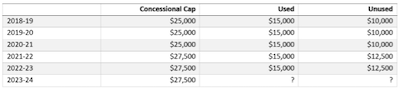
If your super balance is below $500,000 prior to 30 June, and you want to quickly increase the amount you hold in super, you can utilise any unused concessional super contributions amounts from the last 5 years.


For example, a taxpayer has only been using $15,000 of the concessional super cap for the last few years. The super balance at 30 June 2023 was $300,000, so this person is well within the limit to make catch up contributions.

A table with numbers and textDescription automatically generated


This person could access their $27,500 concessional cap for 2023-24 plus the unused $55,000 from the prior 5 financial years.
However, if the unused amount from 2018-19 is not used by 30 June 2024, the $10,000 will no longer be available.


Taxation


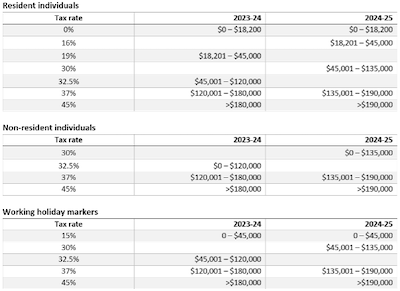
As we all know, the revised stage 3 tax cuts have passed Parliament and will come into effect on 1 July 2024. The following table outlines what the rates currently are and what they will be from the 2025 financial year.

A table of income taxDescription automatically generated with medium confidence


Salary sacrifice agreements should be checked before the new tax rates come into effect to ensure they will continue to produce the result you are after.


Be sure to contact us if you have any concerns or questions.


20th-April-2024
 
sitemap | site by AcctWeb